
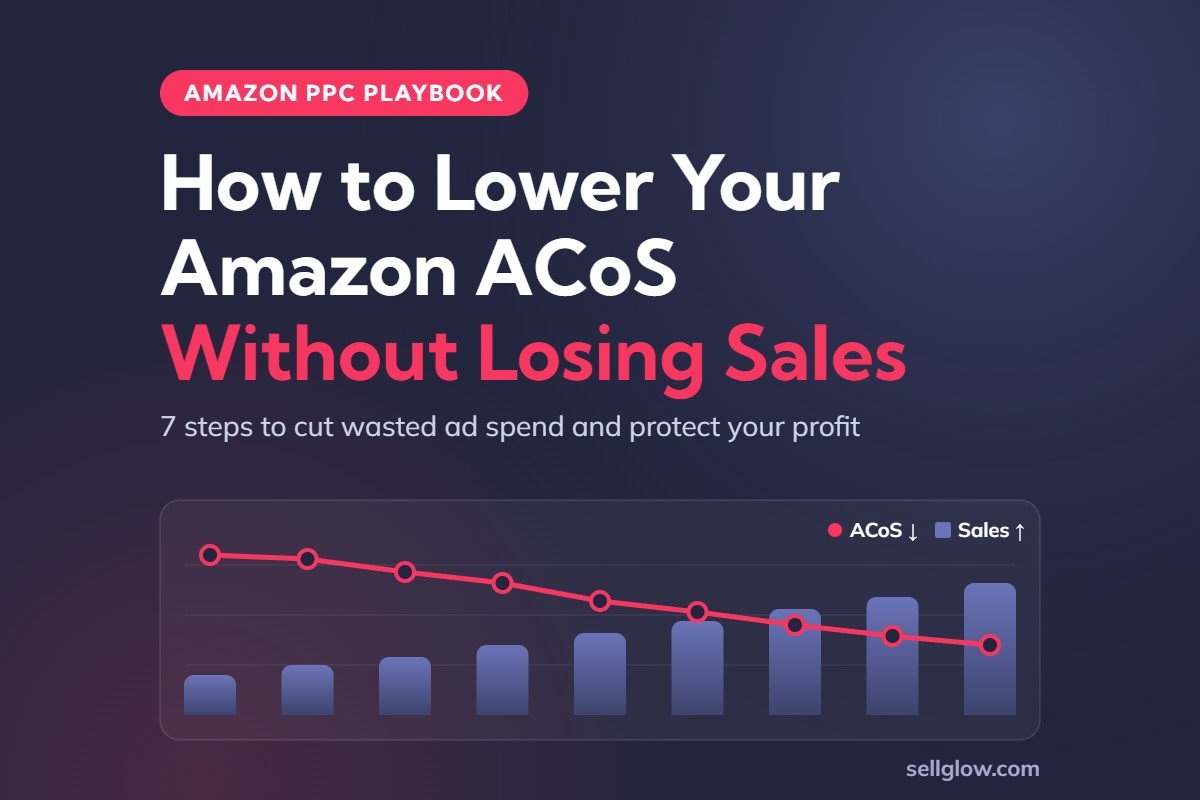
High ACoS is the most common complaint we hear from Amazon sellers. Campaigns are spending, sales are coming in, but the margin is disappearing into ad costs. The good news is that a high ACoS is rarely a mystery. It usually comes from a few fixable problems: wasted spend on irrelevant search terms, bids that ignore your margins, and messy campaign structures.
Here are the seven steps we use to bring ACoS down without starving the products that are actually selling.
1. Know your break-even ACoS before you touch a bid
ACoS (Advertising Cost of Sales) is your ad spend divided by your ad-attributed sales. On its own, the number means very little. A 35% ACoS is a disaster for a product with a 25% margin and perfectly healthy for one with a 50% margin.
Start by calculating your break-even ACoS: your selling price minus all costs (product cost, Amazon referral fee, FBA fees, shipping to Amazon, returns), divided by the selling price. That is the most you can spend on ads per sale without losing money. Set your target ACoS below it, lower in a profit phase and closer to it during a launch.
2. Watch TACoS, not just ACoS
TACoS (Total Advertising Cost of Sales) divides ad spend by your total sales, organic and paid together. It tells you whether advertising is growing the business or simply replacing sales you would have made anyway. A falling TACoS usually means ads are lifting your organic rank; a rising one means you are becoming more dependent on paid traffic.
3. Mine the search term report every week
Your search term report shows the actual customer searches that triggered your ads. This is where most wasted spend hides. Pull the last 30 to 60 days, sort by spend and look for two groups:
- Converting terms with orders at or below your target ACoS. These are candidates to move into their own exact-match campaign.
- Bleeding terms with meaningful clicks and spend but no orders, or an ACoS far above break-even. These are candidates for negative keywords.
Give each term a fair chance, roughly the number of clicks your product usually needs to make one sale, before you judge it.
4. Use negative keywords aggressively, but precisely
Add irrelevant and non-converting search terms as negative exact keywords in the campaigns that triggered them. Use negative phrase for terms that are clearly wrong in any combination, such as a competitor’s brand name you do not want to bid on or a product type you do not sell.
When you graduate a winning search term into an exact-match campaign, add it as a negative exact in the auto, broad and phrase campaigns it came from. This stops your own campaigns from competing against each other.
5. Structure campaigns so the data is readable
One campaign with every product and every match type mixed together makes optimization guesswork. A simple structure works far better:
- Auto campaigns for discovery, letting Amazon find new search terms and product targets.
- Broad and phrase campaigns for controlled research around your core keywords.
- Exact-match campaigns for proven keywords, where you control bids tightly.
- Product targeting campaigns for competitor ASINs and complementary products.
When each campaign has a single job, you can see at a glance which job is costing too much.
6. Set bids from data, and choose the right bidding strategy
A practical way to set a keyword bid is to work backwards from your target: multiply your target ACoS by your average order value and your conversion rate for that keyword. If your target ACoS is 25%, your average order is $40 and the keyword converts at 10%, a sensible bid is around $1.00 per click.
For campaigns that are still finding their feet, dynamic bids – down only is the safer choice, because Amazon lowers your bid when a sale looks less likely. Reserve up and down for proven exact-match campaigns where you are comfortable paying more for high-intent placements. Then check placement performance: if top-of-search converts far better than product pages, add a placement adjustment there instead of raising every bid.
7. Fix the listing before you blame the ads
PPC sends shoppers to your product page; the page has to close the sale. If click-through rate is low, look at your main image, price and review rating. If clicks are healthy but conversion is low, look at your title, bullets, A+ content and price against competitors. Improving conversion rate lowers ACoS on every keyword at once, which no amount of bid tweaking can match.
Make it a routine
Lowering ACoS is not a one-time cleanup. A weekly routine of reviewing search terms, adding negatives, graduating winners and adjusting bids steadily pushes wasted spend out of your account.
If you would rather have experts handle it, Sell Glow’s Amazon PPC management service does exactly this every week. Browse our case studies to see the results, or contact us for a free account audit.

